| An AI data analyst agent is software that takes a business question, finds and queries the right data, cleans and analyses it, and returns an answer, chart or report. It works within the bank’s access rules and logs what it did. Unlike a fixed dashboard, it handles new questions; unlike a basic chatbot, it works on governed, live data. |
| TL;DR
1. An AI data analyst agent turns a plain-language question into a governed query, runs it, checks the result and explains it with charts or reports. 2. It differs from a BI dashboard (fixed views) and from a general chatbot (no governed access to your data). 3. The hard part is accuracy. A 2025 research benchmark, Spider 2.0, found that language models needed significant improvement for real enterprise database work. A shared definition layer for metrics (a semantic layer) helps. 4. Banks can use these agents for management reporting, portfolio and collections monitoring, onboarding funnels and data quality checks. 5. Governance comes first: access controls, lineage, audit logs and human review of important numbers. 6. They are more likely to change analysts’ work than to replace it. Analysts move toward defining metrics, validating results and interpreting them. 7. Start small: 10 to 20 real recurring questions, a test set of approved answers, and a side-by-side trial. 8. The last section shows how SimplAI Data Analyst Agent fits, and how to see it on your own data. |
Every bank has a queue of data requests. A business head wants branch-level numbers, a risk team needs a trend by Monday, and the analytics team is already stretched. Reports take days, and the numbers sometimes differ between teams. This guide explains what an AI data analyst agent is, how it works, where it fits in a bank, and how to judge whether you can trust it.
In this guide
- What an AI data analyst agent is, and what it is not
- How it works, step by step
- Text-to-SQL, and why accuracy is hard
- Where banks use it
- Benefits and limits
- Will it replace data analysts?
- Risks and governance
- How to start, and a readiness checklist
- FAQs
- How SimplAI helps
What is an AI data analyst agent?
An AI data analyst agent does the work a data analyst does on a routine request, but in minutes and under controls. It has four parts:
- Question understanding. A language model reads the request and works out which metrics, filters and time period it refers to.
- Data access. The agent connects to approved data sources, such as a data warehouse, and writes and runs queries, often in SQL (Structured Query Language).
- Analysis and presentation. It cleans the data, runs the calculation, and builds a table, chart or written summary.
- Delivery and control. It can send reports or alerts, and it records the query, the data used and who asked.
The word “agent” matters. A plain chatbot answers from its training or from documents you paste in. An agent takes steps: it looks up the schema, runs a query, checks whether the result looks right, and tries again if it does not. For a short guide to that difference, see our article on agentic AI in banking .
How it compares with other tools
Our analysis. Strengths and limits vary by product.
| Tool | What it does well | Where it falls short |
|---|---|---|
| BI dashboard | Fixed, trusted views with agreed metric definitions; fast to read | New questions need an analyst to build a new view |
| General-purpose chatbot | Explains concepts and drafts text; handles pasted data | No governed access to bank data; hard to audit; risk of data leakage |
| Human data analyst | Judgement, context and accountability | Limited capacity; slow on repetitive requests |
| AI data analyst agent | Handles new, ad hoc questions on live data; cleans data; builds charts and reports; logs its steps | Needs governed data, clear metric definitions and review; accuracy must be tested |
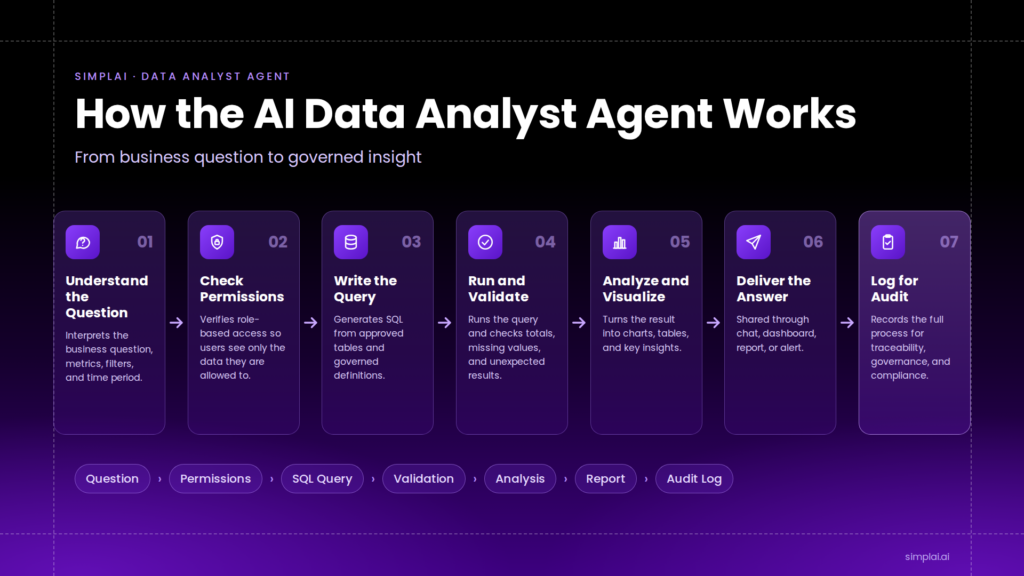
How an AI data analyst agent works, step by step
Illustrative example, not a customer case. A regional head asks: “Which branches had the biggest rise in loans more than 30 days past due last quarter?”
| Step | What happens | Control to look for |
|---|---|---|
| 1. Understand the question | The agent maps “past due”, “last quarter” and “branch” to defined fields and metrics | A shared metric dictionary or semantic layer, so “past due” means the same thing everywhere |
| 2. Check permissions | The agent confirms the user may see branch-level loan data | Role-based, row-level and column-level access, enforced by the data platform |
| 3. Write the query | It generates a SQL query against approved tables | Read-only access; query shown to the user |
| 4. Run and check | It runs the query and tests the result: row counts, missing values, totals against a known figure | Automated sanity checks; flags for odd results |
| 5. Analyse and visualise | It ranks branches, builds a chart and writes a short summary | Summary cites the data source and date |
| 6. Deliver | The answer appears in chat, a dashboard or a scheduled report; an alert goes out if a threshold is crossed | Distribution limited to approved recipients |
| 7. Log | The question, query, data version and output are recorded | Audit log that can be exported |
If any step fails, a well-built agent stops and asks for help instead of guessing. That behaviour is one of the main differences between a demo and a bank-ready tool.
Text-to-SQL, and why accuracy is hard
Text-to-SQL, also called natural language to SQL, is the step that turns a plain-English question into a database query. It looks simple in a demo. In a real bank it is not, because:
- Warehouses hold hundreds of tables and columns with unclear names.
- The same business term (“active customer”, “NPA”, “revenue”) can be defined differently by different teams.
- Queries must follow the dialect of the platform, such as Snowflake or BigQuery.
- A query can run without error and still be wrong, for example by joining tables incorrectly.
Researchers have measured this gap. Spider 2.0, an academic benchmark presented at ICLR 2025, contains 632 real-world enterprise text-to-SQL workflow problems. Its authors conclude that language models need significant improvement before they reach adequate performance for real enterprise use. At the time of the paper, the best reported setup solved only about one in five of the full set of tasks, far below the 90% or more that models reach on simpler, older benchmarks. Models improve quickly, so treat the figure as a reminder to test rather than a current score. Sources: Spider 2.0 paper on arXiv (ICLR 2025); AlphaXiv summary of results.
What helps accuracy in practice:
- A semantic layer: one governed place where metrics, joins and definitions live. Gartner’s 2026 data and analytics predictions say developing a universal semantic layer is now a must-do for leaders working on AI. Source: Gartner press release, 12 March 2026 (via HPCwire).
- A test set of real questions with approved answers, run before and after every change.
- Validation checks that compare results with known totals.
- Human review of numbers that go to the board, a regulator or a customer.
Where banks use AI data analyst agents
Illustrative examples of questions an agent could answer. Confirm data availability in your own environment.
| Use case | Example question | Who benefits | Human check |
|---|---|---|---|
| Management reporting (MIS) | Produce this week’s branch performance pack | Business heads, finance | Analyst validates key figures |
| Credit portfolio monitoring | Which segments show rising delinquency this quarter? | Credit and risk teams | Risk head reviews trends and thresholds |
| Collections performance | Which agents and regions have falling recovery rates? | Collections heads | Operations lead confirms causes |
| Onboarding funnel | Where do applicants drop out of KYC? | Operations, product | Product owner interprets |
| Customer analytics | Which customer groups are reducing balances? | Retail and marketing | Analyst checks segments and sample sizes |
| Finance variance analysis | Why did operating cost rise against budget? | CFO office | Finance controller signs off |
| Data quality checks | Find duplicate or mismatched records across sources | Data and compliance teams | Data owner approves fixes |
| Ad hoc business requests | Give me the top 20 accounts by exposure in this sector | Any business team | Access rules enforce who can ask |
| Want to see this on your own data? SimplAI Data Analyst Agent cleans data, builds dashboards and charts, and produces automated reports with alerts. Book a SimplAI BFSI demo and bring two or three of your recurring reporting requests. |
Benefits and limits
Benefits
- Shorter turnaround on routine and ad hoc requests.
- Smaller backlog for the analytics team, which can focus on harder problems.
- Self-service for business teams, within access rules.
- Consistency, when every answer uses the same metric definitions.
- Traceability, because each answer has a logged query and data source.
Limits
- Accuracy is not automatic. It must be tested on your own data and questions.
- Poor data stays poor. An agent cannot fix missing or contradictory source data on its own.
- Ambiguous questions can produce confident but wrong answers if definitions are unclear.
- Cost can grow with usage, so track cost per question.
- Over-reliance is a risk if people stop checking important numbers.
Gartner puts the wider trend this way: in its 2025 Head of Analytics and Data Science Survey, more than 90% of teams were already using AI, or planning to use it, for tasks from data preparation to code generation. That is a cross-industry figure, and Gartner’s full report is paid; we only cite the public summary. Source: Gartner, Predicts 2026: AI Agents, MCP and Governance Are Transforming Analytics, 19 November 2025 (summary page).
BUILD WITH SIMPLAI
Ready to Build Your Own I Data Analyst Agent?
Go beyond manual data analysis. Explore how SimplAI turns raw data into actionable insights, automated dashboards, and intelligent reports.
Will AI data analyst agents replace data analysts?
This is one of the most searched questions on the topic, so here is a direct answer. In our view, agents are more likely to change the analyst’s job than to remove it. This is our analysis, not a forecast from a named source.
- What agents take over: repetitive queries, data cleaning, routine reports and first-draft charts.
- What stays with people: defining metrics, deciding which data is trustworthy, validating results, explaining what the numbers mean and taking accountability for them.
- What grows: reviewing agent output, building test sets, and maintaining the semantic layer.
Banks that treat agents as a way to clear the backlog, and move analysts to higher-value work, will likely see more benefit than those that treat them as a headcount substitute.
Risks and governance in a bank
| Risk | What can go wrong | Control to ask for |
|---|---|---|
| Wrong numbers | A query runs but joins or filters incorrectly | Test set, validation checks, shown query, human review of key figures |
| Data exposure | A user sees data they should not | Role, row and column-level access enforced in the data platform, not only in the agent |
| Metric drift | Two teams get different answers to the same question | Governed semantic layer with owners and version control |
| No audit trail | You cannot show how a number was produced | Logs of question, query, data version, output and user |
| Data residency | Data leaves the approved environment | Deployment in your cloud or on-premise; check where models run |
| Over-reliance | Staff accept answers without checking | Review rules for board, regulatory and customer-facing numbers |
Reporting standards. The Basel Committee’s BCBS 239 principles (January 2013) set expectations for risk data aggregation and risk reporting, including accuracy and integrity, completeness and timeliness. They apply directly to globally systemically important banks, and other banks may use them as a benchmark; check your supervisor’s expectations. An agent that produces risk reports should be able to show how it meets the same standards. Source: Basel Committee, BCBS 239.
India note. The Reserve Bank of India’s FREE-AI committee report (13 August 2025) sets principles and recommendations for AI in the financial sector, including governance, audit and incident reporting. Ask your compliance team how they apply to analytics agents. Source: RBI press release.
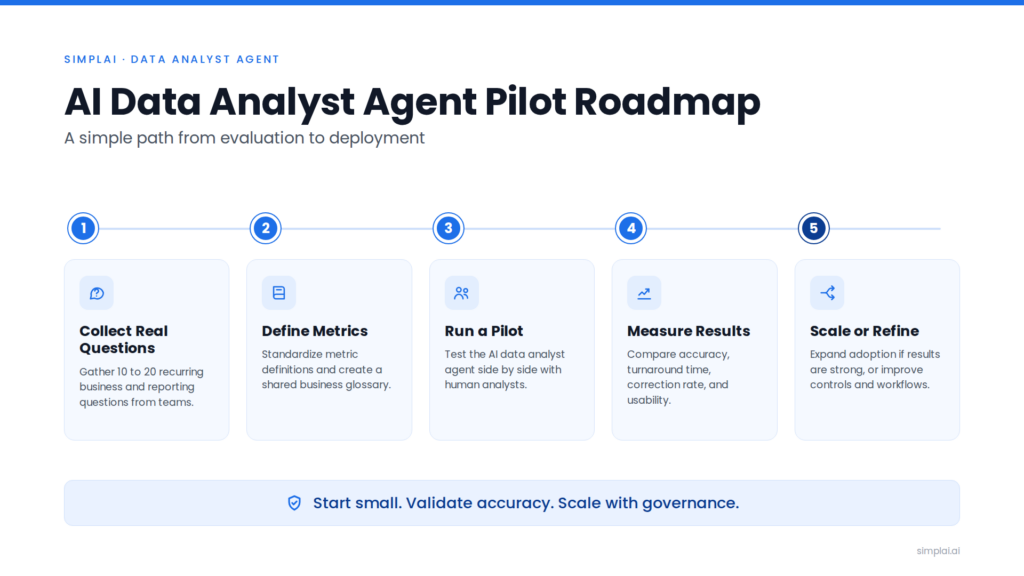
How to start: a simple pilot
- Collect 10 to 20 real recurring questions from business and risk teams, and the approved answers your analysts give today.
- Define the metrics those questions use, and write them into a shared dictionary.
- Run the agent side by side with your analysts on those questions.
- Measure accuracy against the approved answers, turnaround time, and how often a person had to correct the result.
- Decide whether to widen access, tighten controls or stop, using a rule you set in advance.
Readiness checklist
- Data sources identified, with owners
- Metric definitions agreed and written down
- Access rules enforced in the data platform
- Read-only access for the agent
- Test set of questions with approved answers
- Logging of questions, queries and outputs agreed
- Review rules set for board, regulatory and customer-facing numbers
- Deployment and data residency requirements documented
- Success metrics and a stop rule set before the pilot
- Compliance and information security have reviewed the plan
Frequently asked questions
What is an AI data analyst agent in simple terms?
Software that answers business questions from your data. It finds the data, runs the analysis, checks the result and returns a chart, answer or report, with a log of what it did.
Is it the same as asking a chatbot about my data?
No. A general chatbot does not have governed, permissioned access to your warehouse and usually cannot show how a number was produced. An agent works on approved data sources and logs its steps.
How accurate is text-to-SQL?
It depends on your data and how well your metrics are defined. Research such as the Spider 2.0 benchmark shows enterprise-scale databases are much harder than simple ones, so test on your own questions before you rely on it.
Can it connect to Snowflake, BigQuery, Power BI or Tableau?
Many tools can. Check the exact connectors and permission model with each vendor.
How do we keep bank data secure?
Enforce access rules in the data platform, use read-only access, log every query, and choose a deployment model that keeps data in your approved environment.
Will it replace our analysts?
More likely it changes their work, moving them from repetitive requests to defining metrics, validating results and interpreting them. This is our analysis.
How do we measure whether it works?
Compare against your analysts’ approved answers for accuracy, and track turnaround time, correction rate and cost per question.
How SimplAI helps
The problems this guide describes are common: slow reports, scattered data, inconsistent numbers and an overloaded analytics team. SimplAI is an enterprise agentic AI platform built for regulated industries. Its Data Analyst Agent is one of its ready banking and finance agents. Based on SimplAI’s solution page, it covers the following.
| Need | What the solution page describes |
|---|---|
| Messy source data | Automated parsing and cleaning, including schema mismatches, duplicates and standardisation across sources |
| Slow dashboards | Real-time dashboards, with auto-built charts, pivot tables and KPI suggestions |
| Manual reporting | Automated reports as PDF and slide decks, with Slack and email alerts |
| Existing BI and data stack | Integrations with Power BI, Tableau, Looker, Google Sheets, BigQuery, Snowflake and APIs |
How it fits the guide. The agent addresses the data-preparation, dashboard and reporting steps described above, and it connects to the tools your teams already use. Pair it with the controls from the governance section: access rules in your data platform, a shared metric dictionary, logging and human review of key numbers.
Security and recognition. SimplAI cites SOC 2 and ISO 27001 and points to its Trust Center. It has also been featured in analyst research including Everest Group’s PEAK Matrix 2026 and Nucleus Research’s LCAP 2026 .
Honest limits. The solution page, as reviewed for this guide, does not describe plain-language question answering or text-to-SQL as a feature, so ask SimplAI directly whether and how that is supported in your environment . Like any agent, it depends on good source data, clear metric definitions and a review process. If your reporting needs are stable and fully scripted, a simpler BI setup may be enough.
Questions to ask in any demo, including ours:
- Can you run it on our own data and our recurring reporting requests, not a sample?
- How are metrics defined and governed, and who owns them?
- How are access rules enforced, and does the agent see only what each user may see?
- What is logged for each question and report, and can we export it for audit?
- Where does it run, and where does our data go?
- How do you test accuracy, and can we see results on our own test set?
Conclusion: start with the questions your teams ask every week
An AI data analyst agent is useful when it is pointed at real, recurring questions, grounded in governed data and checked by people. It will not fix poor data or unclear metrics, but it can clear the request backlog and give business teams faster, traceable answers. Start with a small pilot, measure accuracy against your analysts’ approved answers, and widen access only when the results support it.
SIMPLAI DATA ANALYST AGENT
Bring Your Data Challenges. We’ll Show You the Agent
Turn recurring banking reports into actionable insights with AI-powered analytics, automated dashboards, and governed workflows.
Author bio