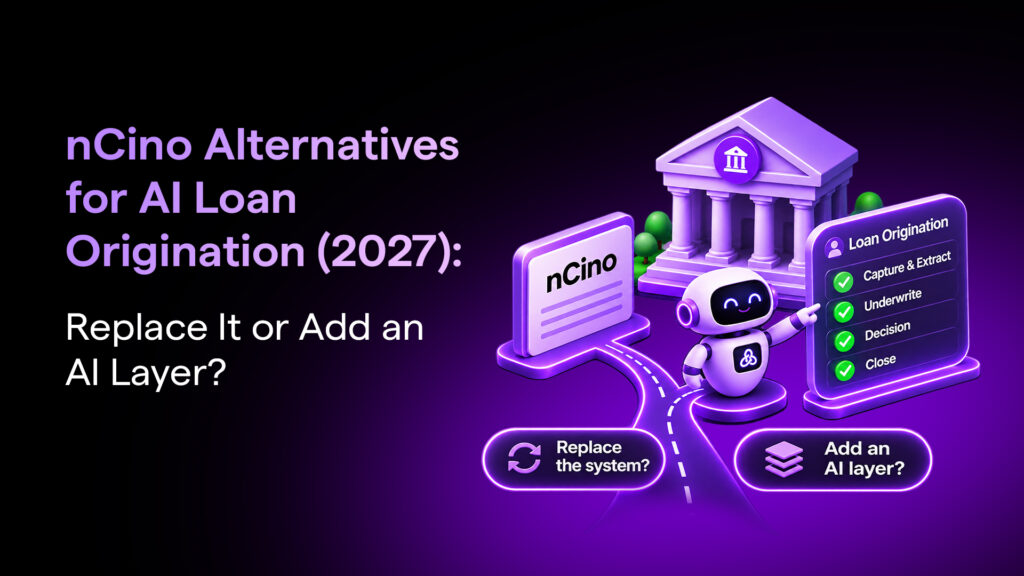
| nCino alternatives for AI loan origination fall into three groups. (1) AI-native loan origination systems that replace nCino, such as SecureLend. (2) AI layers that sit beside nCino and take over underwriting, document or fraud work, such as Aloan, FluxForce’s Lena Credit and SimplAI. (3) Decisioning and document tools used next to any loan origination system (LOS).
Which one fits depends on one question: do you need to replace nCino, or add AI on top of it? Among the vendors reviewed in depth here, only SecureLend is a replacement LOS. Aloan and FluxForce describe themselves as sitting beside an existing LOS. |
| TL;DR
1. “nCino alternative” means two different things: a replacement LOS, or an AI layer that works with nCino. Decide which before you compare vendors. 2. Replacement is a migration project. Sidecar layers describe themselves as needing no data migration, so they are usually the lower-risk first step. 3. Most vendor numbers in this space are self-reported. Treat them as claims to test on your own application files. 4. Whatever you pick, keep a person on credit decisions and decline reasons. 5. SimplAI sits in group 2: an agentic AI operating system for finance and banking that works with your LOS rather than replacing it. |
Search “nCino alternatives” and you get two very different buyers mixed together. One is a bank or lender unhappy with nCino itself: cost, configuration effort or fit. The other is happy with nCino as the system of record but wants faster underwriting, cleaner documents or better fraud checks than the platform provides out of the box. Vendors answer both searches with the same words, “AI loan origination”, even though they sell very different things.
This guide separates them. It covers what each vendor says it does, who it appears to fit, and what to check before you commit. It is based on public vendor materials, press releases and review listings available in November 2027. Check current details with each vendor.
The first decision: replace nCino or add an AI layer
| Group | What it does | Switching effort | Examples in this guide |
|---|---|---|---|
| A. AI-native LOS (replace) | Runs the whole origination workflow: intake, documents, underwriting analysis, memos, compliance checks | High. It is a system migration with integrations, training and parallel running | SecureLend; also on the radar: Casca AI, Dailoqa, Balerion AI |
| B. AI layer beside the LOS (augment) | Reads documents, spreads financials, drafts credit memos, checks files for fraud, then hands a package to your credit team | Lower. Vendors describe API integration with your existing LOS and no migration | Aloan, FluxForce (Lena Credit), SimplAI |
| C. Decisioning and document tools | Scoring, rules, strategy, or document extraction and analytics, used next to any LOS | Medium. Depends on how many systems it must connect to | FICO, Provenir, Ocrolus |
Why this matters. Replacing an LOS changes how every loan file is stored, approved and audited. Adding an AI layer changes how one stage of the work is done, while the system of record, its audit history and its regulator-facing reports stay where they are. If your pain is slow underwriting or messy documents, a layer may fix it without a migration. If your pain is the LOS itself, a layer will not.
Group A: AI-native loan origination systems
SecureLend
What it is. SecureLend, founded in 2025 by Tobias Pfuetze, describes itself as LLM-agnostic AI infrastructure for lending automation. It targets community banks, factoring companies and alternative lenders, and its product listing describes a multi-tenant, white-label LOS covering document collection, classification, extraction, underwriting analysis, compliance checks and credit memo generation.
What its materials say.
- A launch release (15 October 2025) claims origination up to 10 times faster and 60% more cost-efficient, and early pilots with 90% faster processing. These are vendor-stated figures.
- It says institutions can switch between model providers such as OpenAI, Anthropic and Google Gemini, which it presents as avoiding vendor lock-in.
- It lists integrations with FIS, Jack Henry, Xero and QuickBooks, and credit data from Equifax, Experian and Dun & Bradstreet.
- It later announced SecureLend Agents, which can be inserted into an existing LOS through MCP or APIs, so the company is not only a replacement play.
Consider. It is a young company, and its release described SOC 2 Type II monitoring with the audit expected in Q1 2026, so ask for the current report. The public material centres on US community banks. Fit for large institutions, or for lenders outside the US, is not shown in the sources reviewed.
Best for: community and regional banks, factoring firms and alternative lenders that want to replace a legacy LOS with an AI-native one.
Other AI-native names to watch
- Casca AI is described in a 2026 Stanford GSB case study as an AI-native loan origination platform focused on the complexity of US Small Business Administration (SBA) lending.
- Dailoqa announced in May 2026 that AU Small Finance Bank went live with an AI-native LOS built on Dailoqa’s multi-agent platform with AWS. It is an example of a bank-specific build, not a packaged product comparison.
- Balerion AI raised a $6 million seed round in April 2026 for an agentic platform that manages mortgage loan files from application to closing. Relevant if you are looking at alternatives to the nCino Mortgage Suite.
These three are covered from single sources. Read each company’s own materials and ask for references before shortlisting.
Group B: AI layers that sit beside nCino
Aloan
What it is. Aloan is an AI underwriting platform for commercial lenders, based in Houston, Texas. Its launch release (24 March 2026) says it takes banks and credit unions from raw financial documents to committee-ready credit memos in under 30 minutes, with every figure traced to its source document. That time is vendor-stated.
What its materials say.
- It ingests the bank’s credit policy and memo template, then produces cited credit memos.
- Features include automated tax return and financial statement spreading, global cash flow, covenant monitoring and AI-assisted risk assessment.
- The release says it integrates with LOS such as nCino and Abrigo, handling underwriting analysis; at Finovate it described sitting beside existing systems with no migration and typical go-live within 30 days (vendor-stated).
Consider. Aloan is focused on commercial underwriting, so it does not cover consumer or mortgage origination in the sources reviewed. Public review volume is small (a single review on G2 at last check), and as a young vendor its long-run examination history is thin. Ask for bank references.
Best for: community banks, credit unions and non-bank commercial lenders that keep their LOS and want faster spreading and credit memos.
FluxForce (Lena Credit)
What it is. FluxForce AI builds AI agents it calls SuperHumans for regulated financial operations, with a focus on fraud prevention, compliance automation and payment security. Lena Credit is its agent for loan underwriting and fraud detection.
What its materials say.
- Lena Credit sits between the LOS and credit officers, checks each file for fraud and inconsistency, and hands the file over with findings attached. The credit officer still makes the decision.
- It connects beside your systems through APIs, and the LOS stays where it is.
- Deployment starts in shadow mode, then moves to the level of autonomy the bank sets.
- The company says every decision maps to ECOA, TILA, HMDA and fair-lending requirements with an audit trail (vendor-stated).
Consider. The emphasis is fraud and underwriting checks rather than end-to-end origination. At least one product page we saw contained placeholder text, so confirm what is live today and ask for production references.
Best for: lenders whose main worry is fraudulent income documents, synthetic identities and audit-ready underwriting files on top of an existing LOS.
SimplAI
What it is. SimplAI is an agentic AI operating system for finance and banking: one platform where agents for onboarding, documents, lending, credit analysis and collections run under shared governance. For approvals it offers the Accelerate Loan Approvals Agent and the Agentic Loan Processing Workflow.
What its solution pages describe.
- Document validation across 70+ document types in loan processing, with bureau checks, deduplication, reference verification and checklist validation.
- Risk assessment including debt-to-income ratios, and a decision package with risk scores, compliance verification and recommendations for final human review.
- Audit-ready trails, integration with loan origination systems and credit risk engines, SOC 2 and ISO 27001, and cloud or on-premise deployment options for credit workflows.
Fit and limits. SimplAI does not replace nCino. It works with your LOS and decision engine, and it needs credit policy that can be written down and tested. It pays off most when you plan to automate several workflows (KYC, document screening, spreading, approvals, collections) under one set of review gates and logs. If you only need commercial memo drafting or only fraud checks, a specialist tool may be simpler. Test accuracy on your own files.
Best for: banks and NBFCs that keep their LOS and want agents across the lending journey with human review and audit trails.
Group C: decisioning and document tools
A third route is neither a new LOS nor an end-to-end AI layer: a decisioning engine for scores and strategy, or a document analytics tool for bank statements, pay stubs and tax forms. FICO, Provenir and Ocrolus are in this group. We compare them against agent platforms in our guide to the best loan approval automation AI agent platforms, so we do not repeat that comparison here.
Does nCino support third-party AI agents?
Yes, in part. nCino describes itself as a platform for agentic AI banking and says its Agentic Operating System governs how its own agents are deployed and monitored. For mortgage, its 7 August 2026 announcement introduced a Mortgage MCP that lets lenders connect MCP-compatible AI agents to the nCino Mortgage Suite inside nCino’s compliance and permissioning framework.
This is a useful signal for the replace-or-augment decision: the incumbent is opening a path for outside agents, which strengthens the case for layering. What it does not tell you is how much access outside agents get across the rest of nCino, or how that access is priced. Ask nCino directly.
Comparison table
Based on public vendor materials dated above. Figures marked (v) are vendor-stated.
| Vendor | Group | Replaces nCino? | Segment described | What to verify |
|---|---|---|---|---|
| SecureLend | A: AI-native LOS | Yes | Community and regional banks, factoring, alternative lenders (US) | 10x and 60% claims (v); current SOC 2 report; fit outside US |
| Aloan | B: AI layer | No | Commercial lending at banks, credit unions, non-bank lenders | Under-30-minute memo (v); bank references; handling of annual reviews and amendments |
| FluxForce (Lena Credit) | B: AI layer | No | Underwriting and fraud checks across lending | Which features are live; production references; policy mapping claims (v) |
| SimplAI | B: AI layer | No | Banks and NBFCs automating several lending workflows | Accuracy on your files; fit with your LOS and decision engine |
| Casca AI, Dailoqa, Balerion | A: AI-native | Yes (per sources) | SBA lending; bank-specific build; mortgage | Single-source mentions only; read first-party material |
How to decide
| If this describes you | Look first at | Why |
|---|---|---|
| Your LOS contract is ending and you want an AI-native system | Group A | Replacement is on the table anyway, so migration cost is already priced in |
| You are deep in nCino and your bottleneck is underwriting speed | Group B | A layer targets the bottleneck without a migration |
| Your biggest risk is fraudulent documents or identities | A fraud-focused layer such as FluxForce, then compare | The control gap is the priority |
| You do commercial lending and need faster spreading and memos | Aloan or a broader layer | Memo prep is the repeatable manual work |
| You want KYC, documents, approvals and collections under one set of controls | A multi-agent platform such as SimplAI | Shared review gates and logs across workflows |
| You are a mortgage lender comparing nCino Mortgage Suite options | Mortgage-focused names such as Balerion AI, plus nCino’s own MCP route | Mortgage workflows differ from commercial lending |
Which fits which lender: banks, credit unions and NBFCs
The vendors with public detail here mostly describe US community banks, credit unions and non-bank lenders. If you are an Indian NBFC, check three things before shortlisting: whether the tool reads the documents you actually receive, such as Indian bank statements and tax records; where data and models run; and how it supports your obligations under the RBI’s Digital Lending Directions, 2025. Have compliance confirm against the primary text.
Questions to ask any vendor
- Are you replacing our LOS or working beside it, and what exactly changes for our existing loan files?
- Can you run on our own application files and credit policy, not a demo set?
- Which LOS integrations are live in production at named customers, including nCino?
- Can we start in shadow or audit mode before the system influences any decision?
- Where are the human review gates, and how are decline reasons tied to source documents?
- Which security reports can we see today, such as SOC 2 Type II, and what is the date of the audit?
- How is it priced: per seat, per loan, per funded volume or by usage, and what integration cost sits outside the quote?
- Which banks can we speak to, and what did they measure?
Keep the decision accountable
Whichever route you take, keep a person on credit decisions and decline reasons. In the US, the Equal Credit Opportunity Act and Regulation B require specific reasons for adverse action, and the CFPB stated in Circular 2022-03 that this applies to complex algorithms (check the circular’s current status with counsel). Faster underwriting does not change that duty.
Frequently asked questions
What is the best alternative to nCino?
There is no single best one. If you want to replace nCino, look at AI-native systems such as SecureLend. If you want to keep nCino and speed up underwriting, look at AI layers such as Aloan, FluxForce or SimplAI.
Is there an AI tool that works on top of nCino?
Yes. Aloan’s launch release names nCino among the LOS it integrates with, and FluxForce and SimplAI both describe working beside an existing LOS through APIs. Confirm the nCino integration is live in production at a customer.
Does nCino allow third-party AI agents?
For mortgage, nCino’s August 2026 Mortgage MCP lets MCP-compatible agents connect to the Mortgage Suite within its permissioning framework. Ask nCino about access and pricing for the rest of the platform.
What are nCino alternatives for NBFCs and credit unions?
Credit unions are a stated segment for Aloan, and community banks and alternative lenders for SecureLend. For NBFCs, shortlist any vendor on document coverage, data location and regulatory fit first, then compare features.
Should we replace our LOS to get AI?
Not necessarily. If the bottleneck is reading documents, spreading financials or checking fraud, a layer beside your LOS can address it without a migration. Replace the LOS when the LOS itself is the problem.
How reliable are the speed and cost figures vendors quote?
Treat them as claims. Ask for the method, the sample size and the document types behind each number, and test on your own files.
Is this a complete list of nCino alternatives?
No. It is a selection across categories, and the market is changing quickly. Other vendors may fit your needs.
SimplAI: an agentic AI operating system for finance and banking
Loan origination does not stand alone. It depends on KYC, document checks, credit analysis and financial spreading, and it leads into servicing and collections. If every stage gets a separate tool, every stage gets separate controls, logs and integrations.
SimplAI is built to avoid that. It is a single platform where agents for onboarding, document checks, lending, credit analysis, collections and reporting run under the same governance, logging and deployment model, and work with the systems a bank already has, including its LOS and decision engine.
| Book a [SimplAI BFSI demo]
Bring a recent loan application file. We will show how the Accelerate Loan Approvals Agent validates documents, assesses risk and prepares a decision package, where human review sits, and how it works beside your LOS. |
Conclusion: choose replace or augment first, then the vendor
Most “nCino alternatives” are not replacements. The ones that are, like SecureLend, ask you to migrate your system of record. The rest add AI to a stage of the work and leave nCino in place. Decide which problem you have, shortlist across groups, run each on the same real files, and insist on human review gates and audit trails you can show a regulator.
Author bio