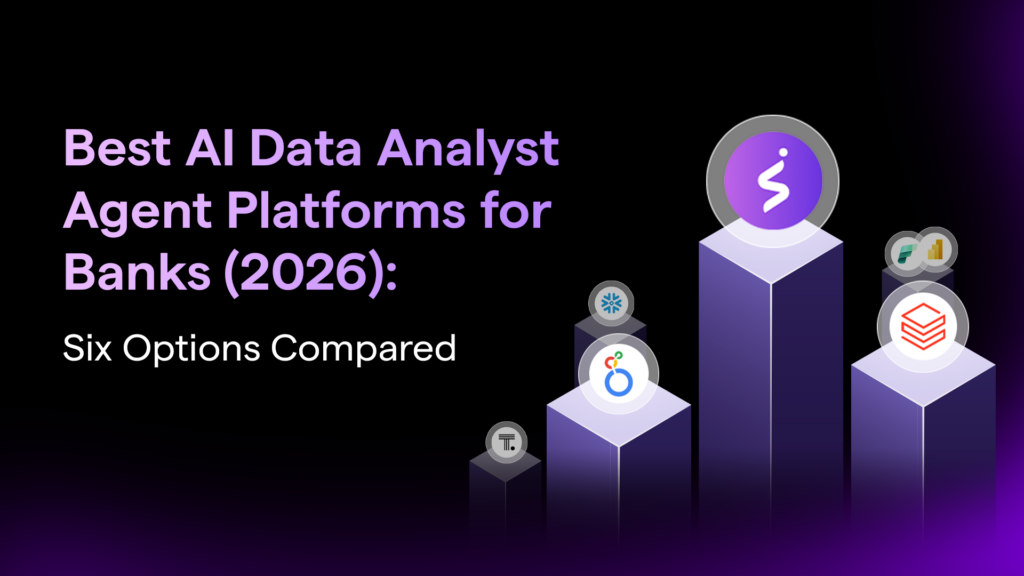
| The best AI data analyst platform for a bank is usually the one that fits its data stack and governance. Databricks, Snowflake, Google Looker, Microsoft and ThoughtSpot work best on their own data or semantic layer. SimplAI, an agentic AI operating system for finance and banking, suits banks that want agents for cleaning, dashboards and reports across existing tools. |
| TL;DR
1. Six options are compared: SimplAI, Databricks, Google Looker, Microsoft Power BI and Fabric, Snowflake and ThoughtSpot. They come from different categories, so “best” depends on your stack. 2. Judge them on governed access, a shared metric layer, accuracy testing, transparency, data preparation, reporting, integration, deployment and cost. 3. Most data-platform and BI options ground answers in a semantic layer. Gartner calls a universal semantic layer a must-do for leaders working on AI. 4. Accuracy must be tested on your own questions. The Spider 2.0 benchmark showed enterprise-scale text-to-SQL is much harder than simple demos suggest. 5. If your bank uses several platforms, an agent layer that works across them can help with data cleaning, dashboards and reports. 6. SimplAI is an agentic AI operating system for finance and banking, and its Data Analyst Agent works across the data and BI tools you already have. The closing section explains how. |
A bank’s data sits in warehouses, BI tools and spreadsheets, and every new question still queues for an analyst. Data platforms, BI tools and agent platforms now all promise AI-powered answers. This guide compares six options and shows how to choose. For the basics, see our guide to what an AI data analyst agent is.
In this guide
- What to look for: evaluation criteria
- The categories of platform
- Quick comparison of the six platforms
- Profiles: SimplAI, Databricks, Google Looker, Microsoft, Snowflake, ThoughtSpot
- How to choose by data stack
- How to test accuracy before you buy
- Questions to ask in any demo or RFP
- FAQs
- SimplAI: an agentic AI operating system for finance and banking
What to look for: evaluation criteria
This is the framework we used for this guide. Apply it to any vendor, including SimplAI. It is our editorial framework, not an industry standard.
| Criterion | What to check |
|---|---|
| Governed data access | Row-level and column-level security enforced by the data platform, so the agent sees only what each user may see |
| Shared metric layer | A governed semantic layer, so “NPA” or “active customer” means the same thing in every answer |
| Accuracy on your questions | Results on a test set of your real questions with approved answers |
| Transparency | Whether it shows the query or logic behind each answer |
| Data preparation | How it handles messy, duplicate or mismatched data before analysis |
| Reporting and alerts | Scheduled reports, dashboards and alerts to the right people |
| Integration | How it connects to your warehouse, BI tools and sources |
| Deployment and data control | Cloud, private cloud or on-premise options; where data and models run |
| Audit logging | Logs of questions, queries, data versions and outputs that you can export |
| Cost model | Licences, usage-based costs, integration effort and the oversight roles needed |
The categories of platform
| Category | What it mainly does | In this list |
|---|---|---|
| Data platform with built-in AI analytics | AI analytics inside the platform that holds your data | Databricks, Snowflake |
| BI platform with AI agents | Dashboards and semantic layers, with conversational and agentic features on top | Google Looker, Microsoft Power BI and Fabric, ThoughtSpot |
| Agentic AI operating system for banking and finance | Agents for data cleaning, dashboards and reports that work across your data and BI tools, on the same platform as agents for other banking workflows | SimplAI |
These categories overlap. A bank may use a data platform for storage, a BI tool for dashboards and an agent platform to coordinate work across them.
Quick comparison
Based on public vendor materials, dated in the profiles below. Check current details with each vendor.
| Platform | Category | Best for | Check before you buy |
|---|---|---|---|
| SimplAI | Agentic AI operating system for finance and banking | Banks wanting agents for cleaning, dashboards and reports across existing data and BI tools | Metric definitions and integration effort; test on your data |
| Databricks | Data platform | Banks whose data estate is on Databricks and Unity Catalog | Works best inside Databricks |
| Google Looker | BI platform | Banks on Google Cloud, or wanting a LookML semantic layer | Needs a performant cloud warehouse and LookML modelling |
| Microsoft Power BI and Fabric | BI platform | Banks standardised on Microsoft 365, Power BI and Fabric | Licensing; Fabric capacity use |
| Snowflake | Data platform | Banks whose data estate is on Snowflake | Semantic model must be built and maintained |
| ThoughtSpot | BI platform | Banks wanting a semantic-layer-first analytics agent across warehouses | Semantic layer set-up effort; cost |
| Want to see this on your own data? SimplAI’s Data Analyst Agent cleans data, builds dashboards and charts, and produces automated reports with alerts, and it integrates with tools such as Power BI, Tableau, Looker, BigQuery and Snowflake. Book a SimplAI BFSI demo and bring two or three of your recurring reporting requests. |
The six platforms
1. SimplAI: an agentic AI operating system for finance and banking
What it is: SimplAI is an agentic AI operating system for finance and banking, built for regulated institutions. Its Data Analyst Agent is one of the ready agents on the platform, and it works across the data and BI tools a bank already uses.
What it does:
- Parses and cleans data automatically, including schema mismatches, duplicates and standardisation across sources.
- Builds real-time dashboards, with auto-built charts, pivot tables and KPI suggestions.
- Produces automated reports as PDF and slide decks, with Slack and email alerts.
- Integrates with Power BI, Tableau, Looker, Google Sheets, BigQuery, Snowflake and APIs.
Fit and limits: The Data Analyst Agent works alongside your warehouse and BI tools. It does not replace your data platform’s access controls or a governed metric layer, so metric definitions and integration still need work. If you only need conversational analytics on a single platform, that platform’s native option may be the simplest start.
Best for: Banks that want agents for data cleaning, dashboards and automated reporting across several data and BI tools, and that may also want other banking agents (KYC, loan processing, credit analysis) on the same platform with shared controls.
2. Databricks: Genie and AI/BI on the lakehouse
What it is: Databricks says Genie is its AI experience for users: one place to ask data questions in natural language, explore AI/BI dashboards and run Databricks Apps, with every answer grounded in the organisation’s data and governed through Unity Catalog. Source: Databricks documentation.
What its public materials emphasise:
- AI/BI combines AI/BI Dashboards with Genie, and respects Unity Catalog permissions and lineage without a separate data extract (Databricks).
- Data teams can configure Genie with instructions, trusted assets and quality monitoring.
- Third-party coverage reports that Databricks announced Genie One, Genie Agents and a Genie Ontology at its Data + AI Summit in June 2026. Confirm on Databricks’ own newsroom before relying on this.
Consider (our analysis): It works best when your data already sits in Databricks and Unity Catalog. Answer quality depends on how well your tables, metrics and instructions are set up.
Best for: Banks whose analytics estate is on the Databricks lakehouse.
3. Google Looker: Conversational Analytics on the LookML semantic layer
What it is: Google describes Conversational Analytics in Looker as Gemini-powered chat with your data, grounded in the Looker semantic model (LookML) as the source of truth. It is available in Looker (Google Cloud core) and Looker (original) instances. Source: Google Cloud documentation.
What its public materials emphasise:
- At Google Cloud Next 2026, Google announced Looker BI Agents that can trigger downstream actions grounded in the semantic layer, and said its Conversational Analytics agent is already generally available (Google Cloud blog).
- Google calls Looker the experience layer for its Agentic Data Cloud, with a semantic layer above the cloud data warehouse and support for MCP-connected tools.
- Conversational Analytics can reach data on platforms such as BigQuery, AlloyDB and Redshift through the Looker semantic model (Google documentation).
Consider (our analysis): Value depends on investing in LookML modelling and on a performant cloud warehouse. Check how features available in preview today are licensed and supported.
Best for: Banks on Google Cloud and BigQuery, or those that want a code-defined semantic layer shared across BI and AI.
4. Microsoft: Power BI, Microsoft 365 Copilot and Fabric Data Agents
What it is: Microsoft announced that Microsoft 365 Copilot can answer questions grounded in Power BI reports and semantic models, respecting existing Power BI and Microsoft 365 permissions. It requires a Microsoft 365 Copilot (Premium) licence plus usual Power BI licensing, is enabled by default and can be disabled by admins. Rollout began in June 2026 for Frontier tenants and in mid-to-late August 2026 worldwide. Source: Microsoft 365 Message Center MC1323266, 26 May 2026.
What its public materials emphasise:
- Query data from Microsoft 365 Copilot is shared with and processed in Fabric to retrieve information, under Fabric’s product terms (same Message Center notice).
- Fabric Data Agents, described by a Microsoft partner, answer natural-language questions across attached Fabric items by generating SQL, DAX or KQL, and return the query used (PA blog). Confirm availability and status in Microsoft documentation.
Consider (our analysis): Check licensing, how Fabric capacity is consumed, and how data moves between Microsoft 365 Copilot and Fabric in your tenant.
Best for: Banks already standardised on Microsoft 365, Power BI and Fabric.
5. Snowflake: Cortex Analyst and Snowflake Intelligence
What it is: Snowflake’s Cortex Analyst is a managed, LLM-powered feature that lets users ask questions about structured data in natural language and returns answers by generating SQL, using a semantic model, through an API. Snowflake Intelligence is an agentic front end that uses Cortex Analyst for structured data and Cortex Search for unstructured data. Sources: Snowflake blog; Keyrus explainer (Snowflake partner).
What its public materials emphasise:
- It runs inside Snowflake’s governed environment, so existing role-based access applies, according to partner descriptions.
- Cortex Agents orchestrate multi-step workflows over structured and unstructured data.
- Usage-based pricing (secondary source; confirm with Snowflake).
Consider (our analysis): Teams must build and maintain the semantic model that grounds answers, and usage costs need monitoring. Confirm feature status in Snowflake’s own documentation, as the sources reviewed here are partly secondary.
Best for: Banks whose analytics estate is on Snowflake.
6. ThoughtSpot: Spotter agentic analytics on a governed semantic layer
What it is: ThoughtSpot calls itself the Agentic Analytics Platform company. Spotter is its enterprise analytics agent for asking questions, investigating drivers and acting on governed data across structured and unstructured sources. Spotter Semantics, announced on 12 March 2026, is its agentic semantic layer, and a ThoughtSpot MCP server connects that layer to AI agents. Sources: ThoughtSpot press release, 12 March 2026; ThoughtSpot Spotter page.
What its public materials emphasise:
- ThoughtSpot states that instead of direct text-to-SQL, Spotter translates questions into search tokens grounded in the governed semantic layer, producing traceable, auditable queries.
- Row-level security and role-based access control are described in its launch coverage (Intelligent CIO).
- Sector versions of Spotter, including one for financial services positioned around fraud detection and regulatory reporting (IT Brief UK, March 2026).
- Integrations with Snowflake Cortex AI and Snowflake Semantic Views, announced on 2 June 2026.
Consider (our analysis): Plan for semantic layer set-up effort and licence cost. ThoughtSpot is a BI-centred platform, so check how it fits alongside your warehouse and other tools.
Best for: Banks that want a semantic-layer-first analytics agent that can sit across several warehouses.
How to choose by data stack
Our analysis. Real decisions often combine tools.
| If this describes you | Look first at | Why |
|---|---|---|
| Your data estate is on Snowflake | Snowflake Cortex Analyst, then ThoughtSpot or SimplAI as complements | Platform-native AI inherits your existing access controls |
| Your data estate is on Databricks | Databricks Genie | Governed through Unity Catalog on your lakehouse |
| You are standardised on Microsoft | Power BI with Microsoft 365 Copilot and Fabric | Works within your existing permissions and licences |
| You are on Google Cloud and BigQuery | Google Looker Conversational Analytics | LookML semantic layer shared across BI and AI |
| You use several platforms and want one semantic layer across them | ThoughtSpot | Semantic-layer-first design across warehouses |
| You want agents for data cleaning, dashboards and reports across tools, plus other banking agents under shared controls | SimplAI | An agent layer that works with your existing data and BI stack |
How to test accuracy before you buy
Accuracy is the hardest part of AI analytics. Spider 2.0, an academic benchmark presented at ICLR 2025, contains 632 real-world enterprise text-to-SQL problems. Its authors conclude that language models needed significant improvement for real enterprise use. Models have improved since, so treat that as a reason to test, not as a current score. Source: Spider 2.0 paper on arXiv.
Gartner’s 2026 data and analytics predictions say that developing a universal semantic layer is now a must-do for leaders working on AI. Source: Gartner press release, 12 March 2026 (via HPCwire).
A simple test:
- Collect 20 to 30 real recurring questions from business and risk teams, with the approved answers your analysts give today.
- Write down the metric definitions those questions use.
- Run each shortlisted platform on the same questions with the same data and access rules.
- Score accuracy against the approved answers, turnaround time, whether the query is shown and how often a person had to correct the result.
- Check access rules by asking questions as users with different permissions.
Questions to ask in any demo or RFP
- Can you run it on our own data and recurring questions, not a sample?
- How are metrics defined and governed, and who owns them?
- How are access rules enforced, and does the agent see only what each user may see?
- Does it show the query or logic behind each answer?
- What is logged for each question and report, and can we export it for audit?
- Where does it run, and where does our data and model processing sit?
- Which security attestations do you hold?
- How do you test accuracy, and can we see results on our own test set?
- What are the full costs, including usage, integration and oversight?
Frequently asked questions
What is the best AI data analyst platform for a bank?
It depends on your data stack and governance needs. Platform-native options fit banks on that platform. BI and agent platforms can sit across several tools.
Do I need a semantic layer?
In practice yes. A governed semantic layer keeps metric definitions consistent across answers, and Gartner calls a universal semantic layer a must-do for AI leaders.
How accurate is text-to-SQL for banking data?
It depends on your data and definitions. Research such as Spider 2.0 shows enterprise databases are much harder than simple ones, so test on your own questions.
Can AI data analyst agents replace analysts?
They are more likely to change analysts’ work, taking over repetitive requests while analysts define metrics, validate results and interpret them. This is our analysis.
How do we keep bank data secure?
Enforce access rules in the data platform, use read-only access, log every query, and choose a deployment model that keeps data in your approved environment.
Which option works across several data platforms?
BI and agent platforms are designed to sit across tools, but check the connectors, permission model and cost with each vendor.
Are the platforms in this list the only options?
No. This is a selection across categories, not a complete market map.
SimplAI: an agentic AI operating system for finance and banking
A data analyst agent is rarely the only agent a bank needs. Reporting depends on clean data from onboarding, loan processing, collections and finance operations, and each of those has its own checks and reviewers. Banks that add a separate tool for each end up with separate controls, logs and integrations.
SimplAI is built to solve that. It is an agentic AI operating system for finance and banking: a single platform where agents for onboarding, document checks, lending, credit analysis, collections, finance operations and reporting run under the same governance, logging and deployment model. The Data Analyst Agent works with the tools you already use, and it runs on the same platform as SimplAI’s other banking agents.
| Need | What the Data Analyst Agent does |
|---|---|
| Messy source data | Automated parsing and cleaning, including schema mismatches, duplicates and standardisation across sources |
| Slow dashboards | Real-time dashboards, with auto-built charts, pivot tables and KPI suggestions |
| Manual reporting | Automated reports as PDF and slide decks, with Slack and email alerts |
| Existing data and BI stack | Integrations with Power BI, Tableau, Looker, Google Sheets, BigQuery, Snowflake and APIs |
| Banking workflow | SimplAI agent or workflow | What the solution page describes |
|---|---|---|
| Onboarding | KYC Automation Agent | Document collection, identity verification, AML and sanctions screening with audit-ready reports |
| Document intake | Document Screening Agent | Extraction, ID cross-checks, flags for incomplete or fraudulent entries |
| Lending | Accelerate Loan Approvals Agent; Agentic Loan Processing Workflow | Document validation, risk assessment, decision packages for human review |
| Credit analysis | Credit Analyst AI Agent; Agentic Financial Spreading Workflow | Spreads, ratios, covenant tests and credit proposals |
| Finance operations | Agentic Accounts Payable Workflow | Invoice capture, matching and exceptions |
| Collections | Debt Collection Agent | Voice-based outreach and arrangements with logged offers |
| Reporting | Data Analyst Agent | Dashboards and automated reports |
What this means in practice. One platform means one place to define review gates, one audit log format and one deployment model across these workflows. SimplAI cites SOC 2 and ISO 27001 and maintains a Trust Center. It has also been featured in analyst research, including Everest Group’s PEAK Matrix 2026 and Nucleus Research’s LCAP 2026.
Where it fits. The Data Analyst Agent works alongside your warehouse and BI tools; it does not replace a governed semantic layer or your data platform’s access controls. If you only need conversational analytics on a single platform, that platform’s native option may be the simplest start. Whatever you choose, test on your own questions.
Conclusion: shortlist by your data stack and test on your own questions
The best AI data analyst platform for a bank is the one that fits your data estate, respects your access rules and passes a test on your own recurring questions. Start with your stack, insist on a governed metric layer, and keep people in charge of numbers that go to boards and regulators.
| Book a SimplAI BFSI demo
Bring two or three of your recurring reporting requests. We will show how the Data Analyst Agent handles data cleaning, dashboards and reports, what is logged, and how it connects to your data and BI stack. |
Author bio