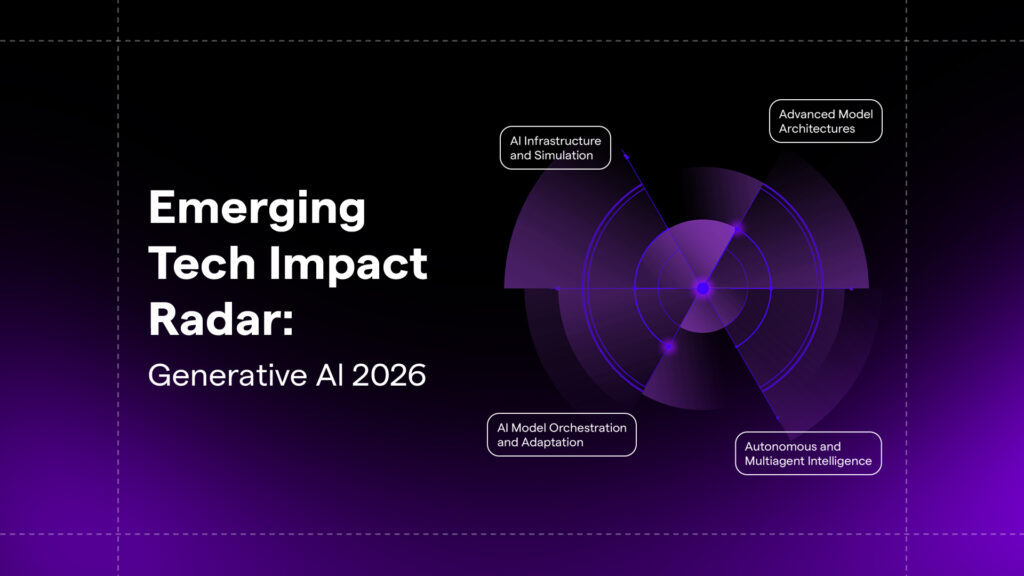
Gartner has recognized SimplAI in its Emerging Tech Impact Radar: Generative AI, published in August 2026. SimplAI is named as a Sample Vendor in the report’s Agentic Operating System profile, a technology Gartner expects to reach early-majority adoption in 1 to 3 years and rates as High mass.
What is Gartner’s Emerging Tech Impact Radar?
The Impact Radar covers 21 generative AI technologies and trends, grouped into four themes: advanced model architectures, autonomous and multiagent intelligence, AI model orchestration and adaptation, and AI infrastructure and simulation. Each item is placed by range, which is Gartner’s estimate of the years until it reaches early-majority adoption, and by mass, which signals how broad and how significant its impact is expected to be. The research is written to help technology product leaders decide when to invest.
How Gartner describes the Agentic Operating System
Gartner defines an agentic operating system as the layer that coordinates AI agents, connects them to enterprise data and applications, and keeps people in control of outcomes. It brings together identity and access control, orchestration, context and memory management, and security and governance guardrails, with humans kept in the loop.
Gartner places the Agentic Operating System in the 1 to 3 years range and gives it a High mass rating. It describes adoption as being in the early-adopter phase, with early use cases such as HR automation, sales enablement, and claims processing. Gartner also expects enterprises to move toward deploying hundreds or thousands of agents each, which raises the need for a reliable control layer.
For finance and operations, Gartner points to early use cases including reconciling records, processing claims, originating loans, and optimizing approval routing.
Where SimplAI fits
SimplAI is the Operating System for Agentic AI, built so enterprises can build, orchestrate, govern, and scale AI agents. Being named as a Sample Vendor in Gartner’s Agentic Operating System profile places SimplAI in the conversation about how enterprises move agentic AI from pilots to production.
The finance and operations workflows Gartner highlights, such as claims processing and loan origination, are areas SimplAI works in through its agents and workflows for financial services and insurance.
What Gartner recommends for agentic deployments
Gartner’s recommended actions in this profile focus on how agentic systems should be introduced and controlled:
- Start with fragmented, cross-tool workflows. Automate repeatable steps first to show measurable savings and fewer errors before scaling.
- Treat agentic workflows like production code. Apply strict least-privilege data access and require human approval for irreversible actions.
- Validate before going live. Offer pre-deployment sandboxes and simulations to test behavior, compliance, and performance. Gartner notes that trust may require tens of thousands of safety simulations.
- Work inside familiar tools. Integrate agents into existing collaboration platforms so context is preserved and agent actions are easy to monitor.
Gartner’s planning assumptions
The report also includes strategic planning assumptions that frame why this matters. By 2028, Gartner expects 99% of agent platform providers to offer simulation environments, up from less than 25% in 2026. It also expects multiagent systems to become integral to enterprise operations by 2028, with at least 20% higher operational efficiency and adaptability than traditional single-agent or centralized AI solutions.
What this means for enterprise teams
- Governance, access control, and human approval are part of the agentic operating system definition itself, not add-ons.
- Simulation and pre-deployment testing are becoming expected, especially in regulated environments.
- Finance and operations workflows are among the first places Gartner sees agentic systems taking hold.
Frequently asked questions
What did Gartner say about SimplAI?
SimplAI is named as a Sample Vendor in the Agentic Operating System profile of Gartner’s Emerging Tech Impact Radar: Generative AI (August 2026).
What is an agentic operating system according to Gartner?
It is a layer that coordinates AI agents, connects them to data and apps, and keeps humans in control, using identity and access control, orchestration, memory management, and governance guardrails.
How far is the agentic operating system from mainstream adoption?
Gartner gives it a range of 1 to 3 years, meaning the estimated time to reach early-majority adoption, with a High mass rating.
Which use cases does Gartner list for finance and operations?
Reconciling records, processing claims, originating loans, and optimizing approval routing.
Where can I read the full report?
It is available to Gartner clients as Emerging Tech Impact Radar: Generative AI, ID G00842957.
Explore more
See how SimplAI helps enterprises build, orchestrate, govern, and scale agentic AI, or browse other independent coverage in the SimplAI Analyst & Industry Research Hub. Book a Demo
Author bio