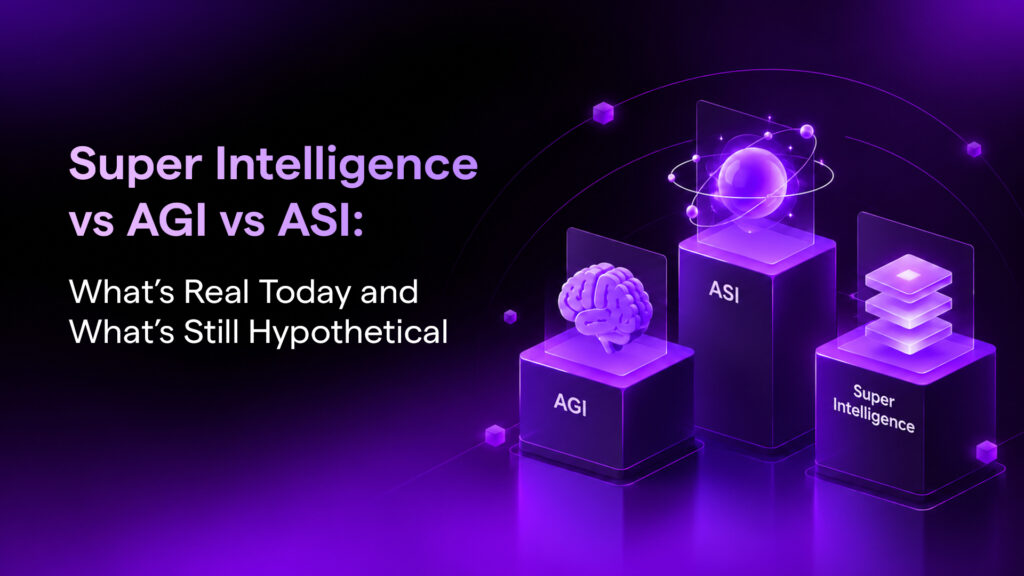
AGI and ASI describe capability levels that remain hypothetical: AGI is AI that matches human ability across a broad range of tasks, and ASI is AI that goes well beyond it. “Super Intelligence” (SI) now has a second, separate meaning as the U.S. federal name for today’s AI, which has no new capability attached. For business planning, the useful distinction is simple: AGI and ASI are research concepts, while the systems you can buy and deploy today, including AI agents, are narrow AI under any of the four names.
This guide focuses on how the four terms differ. For the federal rename itself and the executive order behind it, see our companion guide, What Is Super Intelligence (SI)? How It Relates to AI and Agentic AI.
The Four Terms at a Glance
| Term | Plain-English meaning | Exists today? | Where you will see it |
|---|---|---|---|
| AI (narrow AI) | Software that performs specific tasks such as writing, classifying, predicting or taking actions through tools | Yes | Products, vendor pages, regulations, research |
| SI (federal naming) | The U.S. executive branch’s name for the technologies already covered by the statutory definition of AI | Yes, as a label for today’s AI | Federal agency documents and some vendor branding |
| AGI (artificial general intelligence) | AI that can match human-level ability across a wide range of tasks, not just one domain | No, hypothetical | Research papers, lab roadmaps, investor and media coverage |
| ASI (artificial superintelligence) | AI that greatly exceeds human cognitive ability across virtually all domains | No, hypothetical | Research and policy debate, long-term safety discussion |
The first two rows describe what you can use now. The last two describe what some researchers and companies are working toward or debating.
What Is Narrow AI, the AI You Use Today?
Every AI product in production today is designed or trained for a defined scope. A language model can draft, summarize and reason over text. A vision model can inspect images. An AI agent can chain several of these abilities with tools to complete a multi-step task such as triaging tickets or reconciling records.
These systems can be impressive and still narrow. They depend on the data, tools and permissions they are given, and they can fail in ways a human colleague would not. Agentic AI extends what the software can do, by planning and acting across systems, but it does not change the category.
What Is AGI (Artificial General Intelligence)?
AGI refers to a hypothetical AI that can learn and perform intellectual tasks across many different domains at roughly the level of a capable human, instead of being limited to one specialty. The key idea is generality: the same system could move from drafting a contract to debugging code to planning a project without being rebuilt for each job.
There is no single agreed test for AGI. Researchers and companies define it differently, and some frameworks, such as Google DeepMind’s “Levels of AGI” work, break the question into dimensions like performance and generality instead of a yes-or-no label. That lack of a shared definition is a practical reason to treat any announcement that a product “is AGI” with care.
What Is ASI (Artificial Superintelligence)?
ASI is a hypothetical level above AGI. The philosopher Nick Bostrom, who popularized the term, described a superintelligence as an intellect that greatly exceeds human cognitive performance in virtually all domains of interest. In this sense it is a claim about capability well beyond any person or group of people.
Because ASI does not exist, discussion of it is mostly about long-term research goals and long-term risk. Some AI labs have named superintelligence as a stated mission, which is part of why the word appears so often in headlines. A stated goal is not a delivered capability.
Where Does “Super Intelligence” (SI) Fit?
This is where most of the confusion starts. Before 2026, “superintelligence” almost always meant the ASI idea above. In September 2026, Executive Order 14434 directed U.S. executive-branch agencies to use “Super Intelligence” and “SI” in place of “Artificial Intelligence” and “AI,” and it defined the new term by reference to the existing statutory definition of AI. The order sets no capability threshold.
That gives the same word two meanings:
- SI as a federal label: a name for today’s AI. No new capability is implied.
- Superintelligence as a research concept: a hypothetical system far beyond human ability, which is what ASI describes.
When you see “SI” or “superintelligence,” check which meaning the author intends. Our guide to the federal rename and what it covers gives the details of the order and the vendors that have adopted the label.
How to Tell Which Term Someone Means
Use these quick tests when you read a report, a pitch or a headline.
- Is it deployed and usable today? If yes, it is narrow AI, whatever it is called.
- Does the claim describe matching a human across most tasks? That is the AGI idea, and it needs evidence beyond a product name.
- Does the claim describe going far beyond human ability in nearly every domain? That is the ASI idea.
- Is the context a U.S. federal document or a vendor following federal wording? Then “SI” most likely means today’s AI.
- Is the claim about a goal or a roadmap? Treat it as intent, not capability.
Why These Distinctions Matter for Business Leaders
The terms affect three practical decisions.
- Budget and planning. Investment cases should rest on what current systems can do reliably on your processes, not on a future capability whose timing nobody can state with confidence.
- Vendor evaluation. A vendor that frames an ordinary agent platform as AGI or superintelligence has told you about its marketing, not about its controls or accuracy.
- Risk and governance. Policies need to cover the systems you actually run: access to data, tool permissions, approval steps and audit trails. Those concerns apply to narrow AI today and do not depend on AGI arriving.
How to Read AGI and ASI Claims in Vendor Pitches
Ask these questions before accepting a claim of general or super-human intelligence:
- Which specific tasks was it tested on, and by whom?
- How does it perform on the same task with your data, not a demo dataset?
- What can it do without human approval, and what is blocked?
- Where does it fail, and how are failures detected?
- What changed since the previous version: the model, the tools, the data access or only the name?
A supplier that can answer these plainly is describing a product. One that cannot is describing an aspiration.
What to Do Now: Plan for the AI You Can Deploy
For most enterprises, the productive move is to invest in the systems that exist today and build the governance around them, so that you can adopt stronger capabilities responsibly whenever they arrive.
- Inventory the AI and agent systems already in use, under whichever names they carry.
- Define approval gates and audit logging for any agent that can take actions.
- Keep a glossary that maps AI, agentic AI, SI, AGI and ASI to what each means in your policies.
- Review vendor claims against evidence, not vocabulary.
SimplAI: The Enterprise Agentic AI Operating System
The gap between today’s AI and AGI does not stop enterprises from getting value from agents now. It does mean that reliability and control matter more than labels. SimplAI is the Enterprise Agentic AI Operating System, built to turn AI pilots into scalable enterprise operations. Teams use it to build, orchestrate, govern and scale AI agents across cloud, private cloud, on-prem, hybrid and air-gapped environments.
The five checks from the section above map directly to how an agentic operating system should behave:
| What to check | What SimplAI provides |
|---|---|
| Orchestration | Multi-agent, multi-step execution with lifecycle control, supervision and recovery; dynamic planning and routing across agents, tools and systems; agent-to-agent (A2A) communication for delegation and coordination |
| Control | Runtime control over which tools, APIs and systems each agent can access; RBAC and ABAC; isolated dev, stage and prod environments; budget and policy enforcement at runtime |
| Traceability | Step-level tracing, evaluations and reasoning visibility; decision- and execution-level audit trails for regulatory and internal review |
| Integration | An MCP Gateway that exposes internal APIs as secure, schema-driven agent tools without backend rewrites; integrations with CRMs, analytics and communication tools; orchestration across multiple LLMs |
| Deployment | SaaS, private cloud, VPC, on-prem and air-gapped models, with enterprises retaining ownership of their infrastructure |
On the build side, the platform brings together an Agent Builder for modular, reusable agents with defined roles, memory and evaluation parameters; a Workflow Builder; a knowledge base; evaluation and tracing; and voice intelligence. A library of enterprise-ready agents covers industries such as insurance, banking and finance, HR, marketing and supply chain.
Industry analysts have taken notice: SimplAI was featured in Everest Group’s Process Orchestration Products PEAK Matrix Assessment 2026 and recognized as an Accelerator in Nucleus Research’s LCAP Technology Value Matrix 2026.
To evaluate SimplAI the way this guide recommends, bring a real multi-step workflow, confirm that approval and policy controls hold, and review the trace of a completed run. Book a SimplAI demo to run those checks on a use case from your own environment, or browse the SimplAI agents library to see ready-made agents.
Frequently Asked Questions
What is the difference between AGI and ASI?
AGI refers to AI that matches human-level ability across a broad range of tasks. ASI refers to AI that greatly exceeds human ability across virtually all domains. Both are hypothetical.
Is Super Intelligence the same as AGI?
Not in the federal usage. Under Executive Order 14434, SI is a name for today’s AI and sets no capability threshold. AGI is a separate, hypothetical concept.
Is Super Intelligence the same as ASI?
The words overlap, but the meanings differ. ASI is a hypothetical capability level. The federal “SI” label refers to existing AI technology.
Does AGI exist today?
No widely deployed product is accepted as AGI under commonly cited definitions, and there is no single agreed test for it. Claims that a product has reached AGI should be checked against the definition being used.
Are AI agents a step toward AGI?
Agents make current AI more capable at completing multi-step tasks with tools, but they remain narrow systems that depend on defined data, tools and permissions. Whether and when general intelligence emerges is an open research question.
When will AGI or ASI arrive?
There is no consensus. Estimates vary widely among researchers and companies, so business plans should not depend on a specific date.
Should enterprises plan for AGI?
Plan for the systems you can deploy now, and build governance that will scale. Strong controls, audit trails and human approval steps are useful regardless of how the capability debate resolves.
Why do some companies describe their products as superintelligence?
Sometimes it is a long-term research goal, sometimes it is positioning, and since the federal rename it can also be a naming choice. In each case, ask what the product demonstrably does.
How should I use these terms in internal policy?
Keep regulatory terms as written in laws and standards, and add the other terms to a glossary that maps each to what it means for your organization.
Key Takeaways
- AGI and ASI are hypothetical capability levels; neither is a product you can buy today.
- “SI” has two meanings: a federal label for today’s AI, and the older research idea that corresponds to ASI.
- Deployed AI agents are narrow AI, however they are named.
- Judge vendors by task evidence, controls and reliability, not by vocabulary.
- Plan and govern for the systems you run now.
Author bio