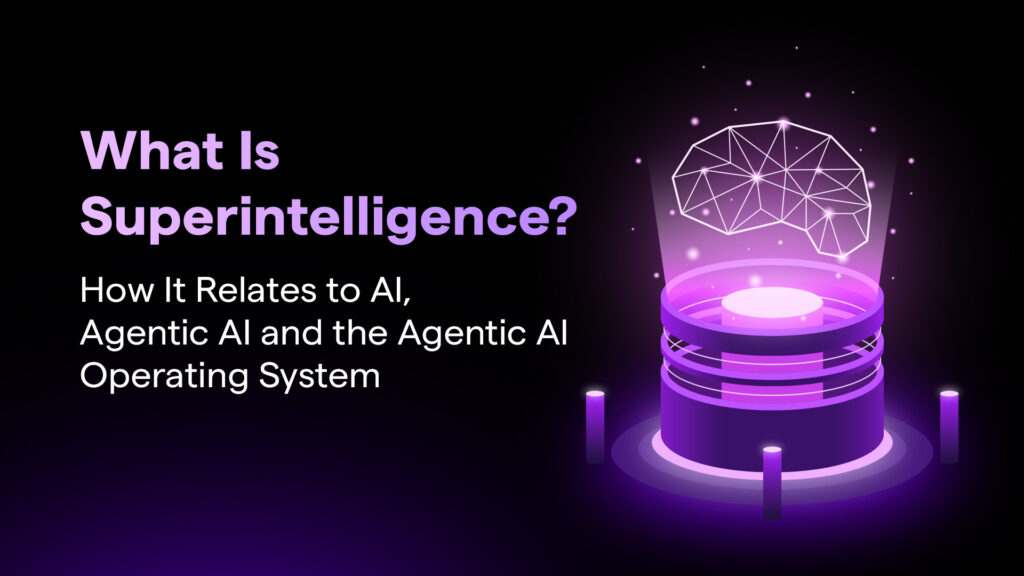
Superintelligence has two meanings, and the difference matters. In research and philosophy, it describes a hypothetical intellect that far exceeds human ability across nearly every domain. Since September 29, 2026, it also has a narrower meaning in U.S. government usage: under Executive Order 14434, executive-branch agencies use “Super Intelligence” (SI) as a naming policy for what the law already defines as artificial intelligence (15 U.S.C. § 9401(3)). The order sets no new capability threshold, so a system described as SI has not been shown to be more capable than the same system described as AI. Agentic AI, meaning software agents that plan and carry out multi-step tasks, falls under the same definition. This guide explains both meanings, what changed, what did not, and how to judge a platform by what it demonstrably does.
What Is Superintelligence?
The word “superintelligence” is now used in two different ways. Reading it correctly depends on knowing which one the author means.
- The research meaning. A hypothetical intellect that far exceeds human ability across nearly every domain. The concept was popularized by the philosopher Nick Bostrom and is used in research discussions about artificial superintelligence (ASI). This is a claim about capability, and no current system is described this way.
- The federal meaning. A naming convention. On September 29, 2026, the President signed Executive Order 14434, titled “Inaugurating the Era of Super Intelligence.” The Federal Register published it on October 2, 2026. Section 1 directs executive departments and agencies, to the maximum extent permitted by law, to use “Super Intelligence” and “SI” in place of “Artificial Intelligence” and “AI” in official correspondence, public communications, websites, reports and other non-statutory documents.
The order defines the new term by pointing back to the old one: SI means the technologies and systems encompassed by “artificial intelligence” as defined in 15 U.S.C. § 9401(3). In practice, SI is a naming change for what organizations already use: machine learning models, large language models and AI agents.
In short: in the federal sense, superintelligence is the new name for today’s AI, not a new class of machine. In the research sense, it is a hypothetical future capability that has not been demonstrated.
What Did Executive Order 14434 Change?
For federal communications, the vocabulary changed and the technology did not. The table below shows what the order changes and what it leaves alone.
| Area | Before EO 14434 | After EO 14434 |
|---|---|---|
| Federal agency websites, reports and correspondence | “AI” / “Artificial Intelligence” | “SI” / “Super Intelligence” |
| Statutes and existing regulations | AI | Unchanged |
| Private companies | AI | Not covered by the order |
| Capability threshold for “SI” | None | None. The order sets no new capability bar |
| Your models, APIs and integrations | Same | Same |
Two points matter for any organization. First, the order applies to the executive branch, not to private firms. Second, it leaves previously issued regulations and statutory references in place, and it calls for proposed legislative language on a formal federal definition of SI at a later stage. Until then, the working definition remains the existing statutory one.
What Is the Difference Between AI and Superintelligence?
For federal communications, there is no technical difference. SI is a label for the systems already covered by the statutory definition of AI, including generative AI and agentic AI. A model does not become more accurate, more capable or safer because its description changed. Judge a system by what it does on your task, with your data.
Is Superintelligence the Same as AGI or ASI?
No. These terms are often confused, so it helps to separate them.
- AI / SI (as used in EO 14434): the systems in use today, including generative AI and agentic AI.
- AGI (artificial general intelligence): a hypothetical system with human-level capability across most domains.
- ASI (artificial superintelligence): a hypothetical tier above AGI, with capability well beyond humans. This is the older, research meaning of superintelligence.
The federal rename does not claim that any current system is AGI or ASI. Business and technology press coverage made the same point: renaming a product does not show that it meets a higher capability bar. A vendor that says “superintelligence” in a pitch deck has not told you anything about what its system can reliably do. Coverage from Tom’s Guide and Solutions Review draws the same line between the naming convention and the hypothetical capability, which is why the two should not be treated as interchangeable.
What Is Agentic AI?
Agentic AI refers to AI systems that can pursue a goal on their own: they plan the steps, call tools and data sources, take actions across business systems, check the result and adjust. A chatbot answers a question. An agent completes a task, such as researching a supplier, reconciling a set of records, triaging a support queue or drafting and routing a contract for review.
Most production deployments combine several agents, each with a narrow role, coordinated by an orchestration layer that handles sequencing, permissions, retries, human approvals and logging. That coordination layer is what turns an impressive demo into something an enterprise can run and audit.
What Is Agentic Superintelligence (Agentic SI)?
Agentic SI is agentic AI described with the new federal vocabulary. Nothing about the agents themselves changes: the same models, the same tool calls, the same orchestration patterns and the same risks. Because “agentic” already suggests autonomy, the phrase can sound like a capability leap. It is not. It is a label applied to software agents that exist today.
What Is an Agentic AI Operating System?
An agentic AI operating system is the layer that sits between your AI models and your business, so agents can be built, run and controlled in one place. Just as a computer operating system manages processes, memory, permissions and devices, an agentic AI operating system manages agents, their memory, their access to tools and data, and a record of everything they do.
This is where the naming debate meets real work. Whether a vendor says AI, agentic AI or superintelligence, an enterprise still has to decide which agent does what, what each one can access, when a human approves a step and how every action is recorded. An operating system for agents exists to answer those questions in one governed environment instead of across scattered pilots.
How Fast Are Vendors Adopting the “SI” Label?
Adoption is uneven and still moving.
- Salesforce announced on October 9, 2026 that its AIForce agent platform is now SIForce. Reporting noted that the announcement did not say whether features, availability or pricing changed.
- SpaceX chief executive Elon Musk confirmed on X that SpaceXAI will be renamed SpaceXSI, although the change had not been completed at the time of reporting.
- OpenAI has said it has no plans to rename the company.
Some vendors are adopting the vocabulary quickly, others are waiting, and none of the renames above came with a published capability change. Expect “SI” and “superintelligence” to appear more often in RFP responses, product pages and analyst reports in the coming months.
What a “Superintelligence” Label Does and Does Not Tell You
A product name is a starting point for questions, not proof of capability. The examples below are illustrative, not test results.
| Claim in a pitch or product page | Question to ask | Evidence to request |
|---|---|---|
| “Our SI platform automates your workflows” | Which workflows, with which inputs and systems? | Named use cases, connectors and a live walkthrough |
| “SI agents act autonomously” | Can the agent only recommend, or also execute? | Permission model, approval gates and audit logs |
| “More intelligent than previous AI” | What changed: the model, data access, tools or permissions? | A specific before-and-after on the same task |
| “Enterprise-grade SI” | Where does it run, and who can see the data? | Deployment options, data-handling and security documentation |
Two points help when reading these claims. First, access is not intelligence: an agent connected to more systems has more information and more authority, which makes it more useful for some tasks but says nothing about general capability. Second, a rename that keeps the same model, tools and permissions gives you no reason to expect different results.
How to Evaluate an Agentic AI Platform, Whatever It Is Called
Whether a platform calls itself AI, agentic AI, an agentic AI operating system or superintelligence, test the same fundamentals:
- Governance and auditability. Can every agent action, tool call and decision be logged, traced and reviewed?
- Human-in-the-loop controls. Can you set approval gates for high-risk steps such as payments, customer communications or system changes?
- Data boundaries and deployment control. Can the platform run in your cloud, VPC or on-premises environment, and does it respect data residency requirements?
- Orchestration reliability. How does it handle multi-agent coordination, retries, failures and long-running workflows?
- Integration depth. Does it connect to your CRM, ERP, ticketing, document and identity systems through governed connectors?
- Model flexibility. Can you swap or combine models without rebuilding workflows?
- Security posture. How are credentials, permissions and tool access scoped for each agent?
A name change is not a capability change, and it is not a control framework. These seven checks apply to every platform on a shortlist.
What Should Enterprise Teams Do Now?
- Map the vocabulary, not the risk. Update internal glossaries so that “AI,” “agentic AI” and “superintelligence” or “SI” resolve to one inventory of systems under your governance policy.
- Keep regulatory wording as written. Where a statute, regulator circular or audit standard uses “artificial intelligence,” keep that exact term in policies and questionnaires.
- Ask vendors one direct question. When a response says “SI,” ask whether it denotes a renamed existing product or a different capability, and request evidence.
- Anchor RFPs to controls. Score vendors on governance, deployment model, integrations and reliability rather than on branding.
- Plan for naming drift. Expect product, analyst and government vocabulary to differ for some time, and make sure search, procurement and compliance teams use mapped terms.
SimplAI: The Enterprise Agentic AI Operating System
The superintelligence label does not change the work of putting agents into production. That work is orchestration and governance: deciding which agent does what, what each one can access, when a human approves a step, and how every action is recorded.
SimplAI is the Enterprise Agentic AI Operating System that transforms AI pilots into scalable enterprise operations. Teams use it to build, orchestrate, govern and scale secure AI agents across cloud, on-premises, private cloud, hybrid and air-gapped environments. It is built for regulated and large organizations, with a strong focus on financial services and insurance.
What is inside the platform
- Agent Builder: create modular, reusable agents with defined roles, memory and evaluation parameters.
- Workflow Builder, Knowledge Base, Evaluation and Tracing: design multi-step workflows, ground agents in enterprise knowledge, and inspect every execution.
- Model and Intelligence Layer: run and orchestrate agents across multiple LLMs with unified reasoning, routing and evaluation.
- Integrations, MCP Gateway and A2A: connect agents to CRMs, analytics and communication tools, expose internal APIs as secure, schema-driven agent tools, and enable structured agent-to-agent delegation and coordination.
- Dynamic Data Ingestion and Voice Intelligence: sync enterprise data in real time and process natural speech, with multi-language support.
How it maps to the seven checks
| Check | What SimplAI provides | How to test it |
|---|---|---|
| Governance and auditability | Decision- and execution-level audit trails, step-level tracing with reasoning visibility, RBAC / ABAC, and environment isolation across dev, stage and prod | Review the log of a completed run, from input to tool calls to output |
| Human-in-the-loop and runtime control | Fine-grained tool and action control, plus budget, policy and execution guardrails enforced at agent runtime | Place an approval gate on a high-risk step and confirm it holds |
| Data boundaries and deployment | SaaS, private cloud, VPC, multi-cloud, on-premises and air-gapped deployment, with enterprise ownership of infrastructure | Confirm where it runs and where your data stays |
| Orchestration reliability | Multi-agent, multi-step execution with lifecycle control, supervision and recovery, plus planning, routing and short- and long-term memory | Build a workflow with more than one agent and observe failures and retries |
| Integration depth | Integrations hub, MCP Gateway for governed tools, and A2A communication | Connect it to one of your own systems rather than a demo dataset |
| Model flexibility | Agents run and are routed across multiple LLMs | Swap the model on one workflow and compare results |
| Security posture | Runtime isolation, native secrets vault, network isolation with private VPCs and endpoints | Review credential and permission scoping for one agent |
Built for regulated industries
SimplAI offers enterprise-ready agents by industry, each operating as a digital colleague for the repetitive, high-risk or time-consuming parts of a workflow. Examples include fraud detection and intelligence, first notice of loss (FNOL) intake, inland marine underwriting, denial management, statement of values (SOV) processing and provider fraud risk in insurance, alongside solutions for loan approvals, credit analysis, financial spreading, loan processing, mortgage origination, servicing and underwriting, and debt collection in banking and finance.
On compliance, the platform is designed to support SOC 2, ISO 27001 and regulated environments, with customer-defined data retention and deletion policies by agent or workflow. For deployment, SimplAI offers expert-led go-live in two days or less, production hardening that includes validation, testing and red-teaming before agents go live, and ongoing enterprise support with SLAs.
Recognized by analyst firms
- Everest Group: featured in the Process Orchestration Products PEAK Matrix® Assessment 2026.
- Nucleus Research: recognized as an Accelerator in the LCAP Technology Value Matrix 2026.
- 451 Research: coverage initiation on SimplAI’s Agentic AI OS from pilot to production, 2026.
- Deep Analysis: vendor profile of SimplAI’s enterprise agentic AI platform, 2026.
Whether a platform’s pages say AI, agentic AI or superintelligence, the checks above show what it can actually do.
Book a SimplAI demo to run them on a use case from your own environment.
Frequently Asked Questions
What is superintelligence?
Superintelligence has two meanings. In research, it is a hypothetical intellect that far exceeds human ability across nearly every domain. In U.S. federal usage since Executive Order 14434, signed September 29, 2026, “Super Intelligence” (SI) is the term executive agencies use in place of “Artificial Intelligence” for the same technologies covered by the existing statutory definition.
What is the difference between AI and superintelligence?
For federal communications, there is no technical difference. SI is a naming convention for AI. The order sets no capability threshold, and existing statutes and regulations are unchanged.
Is superintelligence the same as AGI or ASI?
No. AGI and ASI are hypothetical capability levels beyond today’s systems. ASI matches the older, research meaning of superintelligence. SI under EO 14434 names the technology in use now.
What is agentic AI?
Agentic AI describes software agents that plan, use tools and execute multi-step tasks toward a goal, usually coordinated by an orchestration layer with permissions, approvals and logging.
What is an agentic AI operating system?
It is the layer where enterprises build, orchestrate, govern and scale AI agents in one place, managing agent memory, tool access, permissions, deployment and audit trails. SimplAI is an Enterprise Agentic AI Operating System.
Is agentic AI now called agentic superintelligence?
Some sources now say “agentic SI” for the same thing. The underlying technology, capabilities and risks are unchanged.
Does Executive Order 14434 apply to private companies?
The order directs executive departments and agencies. It does not itself require private companies to rename products or change terminology. Organizations that work with federal agencies should still watch for forms and correspondence that adopt the new wording.
Has the legal definition of artificial intelligence changed?
No. The order defines SI by reference to 15 U.S.C. § 9401(3) and leaves existing statutory references and regulations in place. It does call for proposed legislative language on a federal definition of SI in the future.
Is superintelligence better than AI?
Not by definition. In the federal naming context, SI refers to the same technology that AI covers, so the new word is not evidence of higher accuracy, broader competence or safer behavior. Judge a system by what it does on your task, with your data.
Which companies have adopted the SI name?
Salesforce renamed AIForce to SIForce on October 9, 2026. SpaceX has said SpaceXAI will become SpaceXSI. OpenAI has said it has no plans to rename. This picture may keep changing.
How should enterprises evaluate agentic AI platforms during the AI-to-SI shift?
Use the same criteria as before: governance and audit trails, human-in-the-loop controls, data and deployment boundaries, orchestration reliability, integration depth, model flexibility and security.
Should we change our AI governance policy to say “Superintelligence”?
Not necessarily. Keep regulatory terms as written, and add “SI” and “superintelligence” as recognized synonyms in your glossary so that one inventory covers all naming variants.
Will “AI” disappear from enterprise vocabulary?
It is too early to say. The order covers federal executive communications, and private-sector usage is mixed. Plan for both terms to coexist.
Key Takeaways
- Superintelligence means two things: a hypothetical capability level in research, and a federal naming convention for today’s AI under EO 14434.
- The federal rename is not a capability upgrade. The order covers the executive branch, sets no capability threshold and leaves existing regulations unchanged.
- Agentic AI, and so “agentic SI,” is the same category of software agents in use today.
- AGI and ASI remain separate, hypothetical concepts.
- Vendor renames such as AIForce to SIForce show how fast vocabulary can move, with no published change in features.
- Evaluate agentic platforms on governance, reliability, integration and deployment control, not on the label. An agentic AI operating system such as SimplAI is built around exactly those controls.
Author bio